📅 Updated: July 2026 · Written by Tom · 13 min read
Best Truck Exhaust Systems: Cat-Back, Headers, and What Actually Matters
Exhaust systems are one of those truck mods that people either ignore completely or go way overboard on. I've owned trucks with the factory exhaust, a cat-back system, and a full headers-to-tailpipe aftermarket setup. Here's what actually matters, what's just noise, and why I stopped buying the cheapest option on Amazon.
An exhaust system does three things: moves exhaust gases away from the engine, reduces noise, and controls emissions. Everything else — horsepower gains, sound, looks — is secondary. If you're considering an upgrade, start here.
📖 Contents
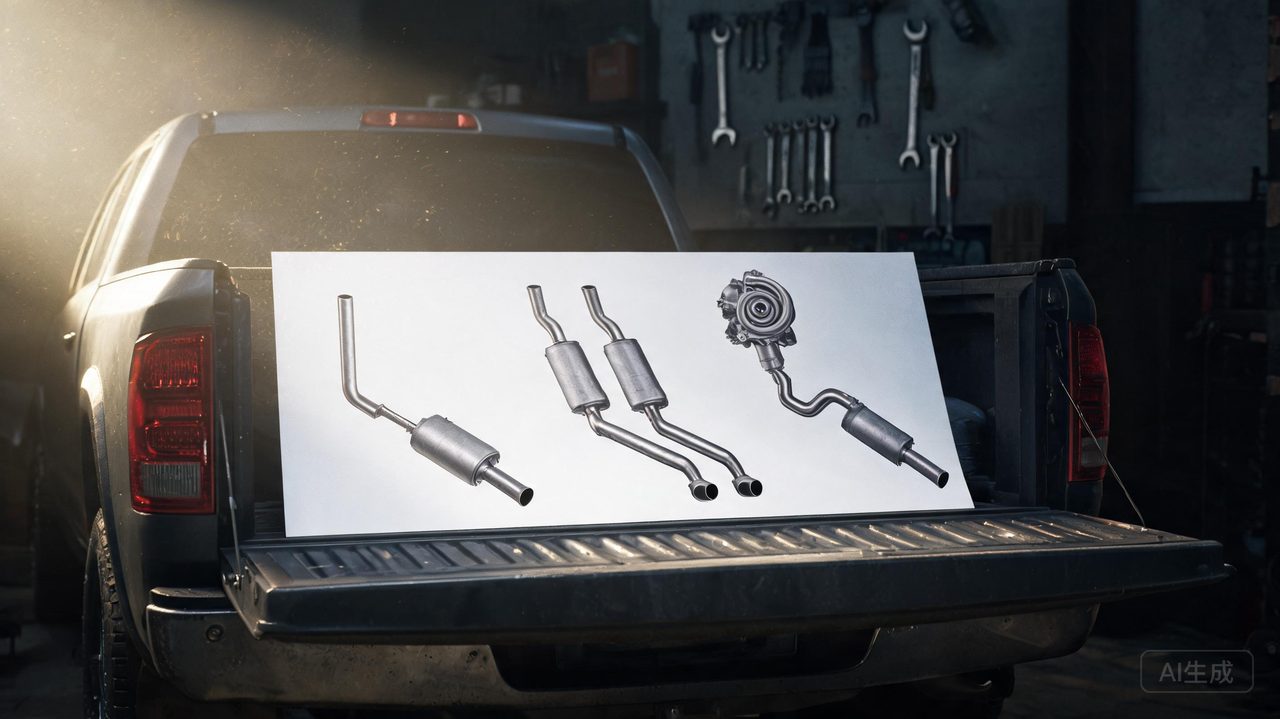
The parts: what each one does
Headers bolt directly to the engine's exhaust ports. They collect exhaust from each cylinder and merge it into one or two pipes. Stock headers are usually cast iron (heavy, restrictive). Aftermarket headers are tubular steel (lighter, better flow). Headers are the most expensive upgrade ($400–1,200) and the most powerful, but they're also the most work to install.
Catalytic converter — the emissions control device. It converts toxic gases into less harmful ones. You can't legally remove it in most states, and aftermarket "high-flow" cats are expensive ($300–800) and only marginally better than stock. Don't mess with this unless you're building a race truck.
Mid-pipe / Y-pipe / X-pipe — the section between the cat and the muffler. Some systems replace this to improve flow or change the sound (X-pipes sound higher-pitched, Y-pipes are deeper). This is where a lot of the "tone" comes from.
Muffler — the noise reducer. Stock mufflers are designed to be quiet. Aftermarket mufflers range from "slightly louder" to "straight pipe loud." This is the cheapest upgrade ($100–300) and the most subjective.
Tailpipe — the visible tip. Mostly cosmetic, but the diameter and finish matter for looks.
Cat-back systems: the sweet spot
A cat-back system replaces everything from the catalytic converter back: mid-pipe, muffler, tailpipe. It's the most popular upgrade because it's a good balance of cost, power gains, and sound without touching the emissions equipment. Expect $500–1,200 installed, 10–20 hp gains (realistic, not the 40 hp some brands claim), and a noticeable sound improvement.
Pros: bolt-on installation (usually), no tuning required, legal in all 50 states (if it keeps the cat), good power-to-cost ratio.
Cons: gains are modest on a stock engine, sound can be too loud for some (check reviews), cheap systems rust quickly.
Best for: daily drivers that want a bit more sound and a small power bump without major work. This is what I run on the F-150.
Headers: the expensive upgrade
Headers are the biggest power gain you can get from an exhaust upgrade, but they're also the most work. Long-tube headers replace the stock manifolds and usually require a new mid-pipe and tuning. Shorty headers are easier to install but give less gain.
Pros: 20–40 hp gains (realistic with tuning), better throttle response, improved exhaust note.
Cons: expensive ($800–1,500 with installation), requires tuning (another $300–500), may not be street-legal in all states, installation is a full-day job (or more) if you're DIY.
Best for: trucks that already have other mods (intake, tuner) and are looking for max power. If you're just doing one exhaust upgrade, cat-back is the better value.
Muffler swaps: cheap sound, no real gains
Swapping just the muffler is the cheapest upgrade ($100–300) and the most popular for people who just want a louder truck. The power gains are negligible (maybe 5 hp if you're lucky), but the sound change is immediate.
Pros: cheap, easy to install (or have a shop do it for $100), lots of sound options from "subtle rumble" to "obnoxious."
Cons: no real power gains, cheap mufflers drone at highway speeds, some states have noise ordinances.
Best for: people who just want sound and don't care about power. If you want both, do a cat-back instead.
The brands I'd trust
- Borla — the gold standard. T-304 stainless steel (doesn't rust), lifetime warranty, great sound. Expensive ($800–1,500 for cat-back), but worth it. I've had Borla systems on two trucks and they still look new after 80,000 miles.
- MagnaFlow — similar quality to Borla, slightly cheaper ($600–1,200). T-304 stainless, lifetime warranty, good sound. I've seen MagnaFlow systems on work trucks that look great after 100,000 miles.
- Flowmaster — the "loud" option. Known for the "Flowmaster tone" (deep, aggressive). Cheaper than Borla/MagnaFlow ($400–900), but they use aluminized steel on some systems (rusts faster). If you want loud and don't mind replacing it in 5–7 years, Flowmaster is fine.
- Gibson — mid-range, good quality, reasonable price ($400–800). T-304 stainless on most systems. Not as well-known as the big three, but solid.
- AP Exhaust / Davico — budget options ($200–400). Fine for a temporary fix or a work truck, but they rust and the sound isn't as refined. I'd avoid these for a daily driver.
Avoid the no-name Amazon/eBay systems. They're usually aluminized steel (rusts in 2–3 years), the fitment is poor, and the sound is obnoxious in a bad way (not aggressive, just raspy).
DIY vs shop: what's involved
Cat-back systems are DIY-friendly if you have basic tools and a jack. You'll need to remove the old system (usually 4–6 bolts), hang the new one, and tighten everything. Total time: 2–4 hours. The hardest part is usually getting the old hangers off (they rust).
Header installs are not DIY for most people. You're working in tight spaces around the engine, often need to remove other components (A/C lines, starter, etc.), and you'll need a tune afterward. If you're not comfortable with engine work, pay a shop.
Muffler swaps are the easiest — usually just 2–4 bolts and some hangers. A shop can do it in 30 minutes for $50–100 labor. DIY in an hour with basic tools.
The legal stuff nobody talks about
Emissions: removing or modifying the catalytic converter is illegal in most states and will fail emissions testing. Keep the cat and you're legal. "High-flow" cats are legal but expensive and only marginally better than stock.
Noise ordinances: some states and counties have noise limits for vehicles. California, New York, and several others enforce this. A Borla or MagnaFlow is usually legal; a straight pipe is not. Check your local laws before going loud.
Warranty: modifying the exhaust doesn't void your entire truck warranty, but it can void the powertrain warranty if the mod causes a problem (like a header causing an O2 sensor code). Dealers are supposed to prove the mod caused the issue, but it's a hassle.
An exhaust upgrade is one of the most satisfying mods you can do — you hear it every time you start the truck. But go in with realistic expectations: cat-back systems give 10–20 hp and a better sound, headers give 20–40 hp but cost $1,500+ installed, and muffler swaps are just for sound. Pick the right upgrade for your goals, spend the money on a quality system (Borla, MagnaFlow), and enjoy it. If you're tracking your total cost of ownership, my truck TCO calculator factors in exhaust mod costs and fuel economy changes over the life of the truck.
I've owned trucks with stock, cat-back, and full exhaust systems. One guy, three trucks, strong opinions about what sounds good and what's worth the money.